
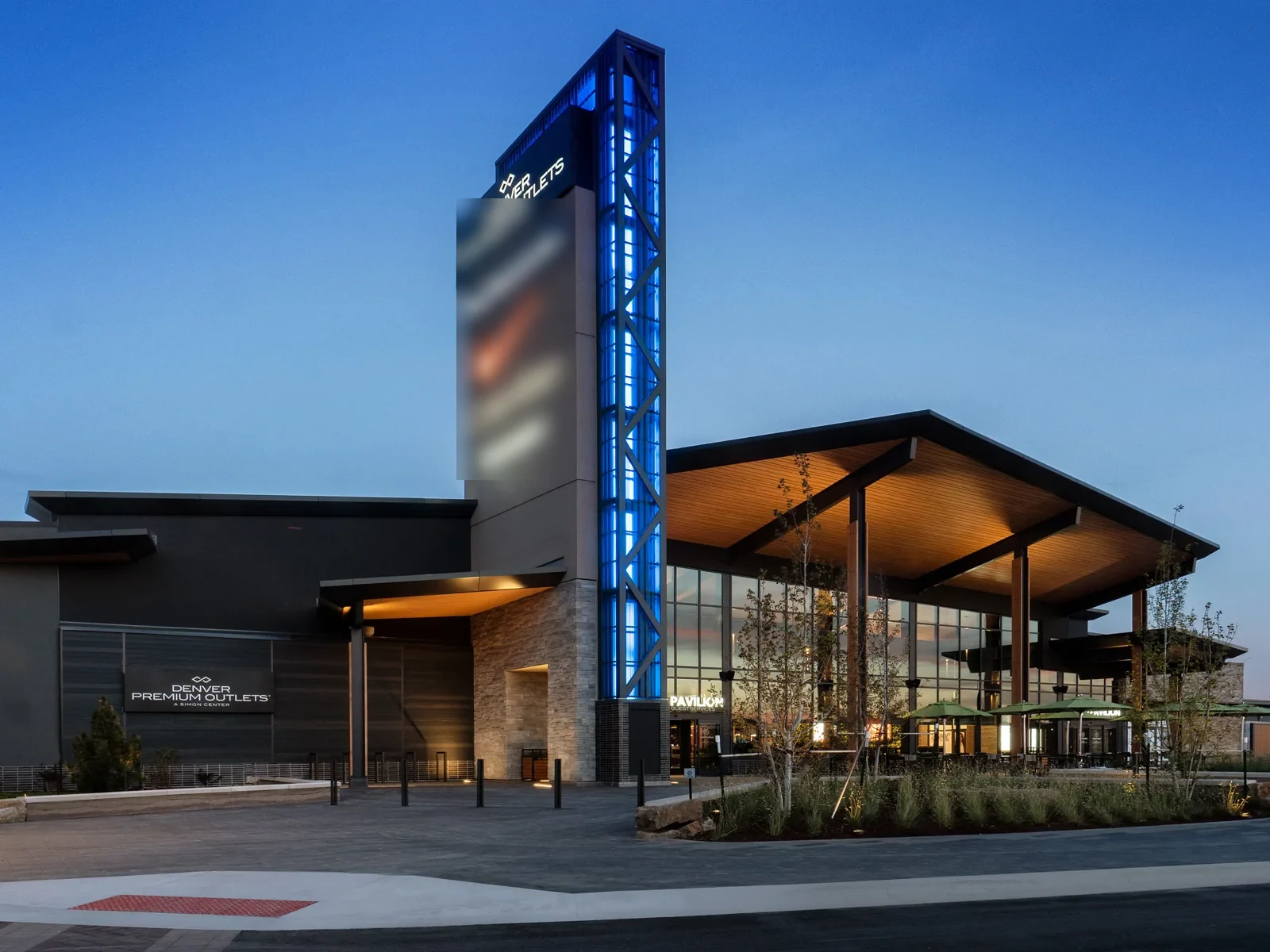
Commercial Roofing at Denver Premium Outlets, Thornton, CO
Coordinate roof repairs and renewal at Denver Premium Outlets in Thornton, CO, around tenant hours, shared areas, access routes and verified roof conditions.
More than 75 outlet stores share the Denver Premium Outlets campus at 13801 Grant Street. Dining, parking and common areas add operating constraints to any roof decision. A leaking tenant bay may be one isolated roof zone, while a drain or edge issue can affect a shared route or neighboring space. We identify the actual building, lease boundary and roof area before assigning work, then plan access around the center’s confirmed operating calendar.
The outlet operator’s description establishes a large-format retail setting, not the condition or construction of a particular roof. We do not assume every tenant shares a membrane, drain path or access point. Our inspection records the assembly where visible, the reported leak location, nearby details and areas that remain inaccessible. That gives ownership a usable basis for repair, testing or replacement.
Tenant sequence: protect trading hours and public routes
Start with a current tenant roster, opening schedule, deliveries, common-area events and any restricted entrance. A roof lift, material staging area or temporary barrier may compete with customer circulation even when the roof work stays above. We coordinate the route with center management and identify who can approve a change. The work plan states which doors, sidewalks or parking areas are affected and when each returns to normal use.
Denver Premium Outlets and Market at 88th represent different retail conditions. The outlet is an operating open-air shopping center; Market at 88th is a cleared redevelopment parcel pursuing new use. We keep their roof questions separate. A second nearby commercial context, Thornton Urban Center, has its own planning boundary and property details.
During inspection, we confirm hatch or ladder access, tie-off points, staging permission, rooftop equipment, tenant demising lines and the route to each roof zone. We also ask which interior spaces cannot be closed or interrupted. Occupied-building phasing can document notices, daily close-in, noise windows and handback conditions before work begins.
Leak triage: trace the report without widening the scope
A ceiling mark inside one store can correspond with a roof penetration, seam, wall transition or drainage path outside its lease line. We map the report to the roof above and inspect adjacent details before recommending a patch. If the source remains uncertain, the condition record names the test or monitoring step that could narrow it. A limited finding stays limited; one tenant report does not prove that every connected roof area has failed.
Hail belongs in the inspection history after the May 30, 2024 event that crossed Thornton and Northglenn. NWS recorded one- to two-inch hail and roof damage. That regional event can inform a timely review, but inspection establishes whether this property has visible impacts. A hail-damage assessment can map dents, punctures, seam disturbance and flashing conditions for the property file.
For a first walk, we photograph membrane surfaces, seams, curbs, pitch pans, drains, scuppers, edge metal and prior repairs. We identify ponding evidence without treating a single visit as a long-term drainage study. Where moisture below the surface would change removal quantities, we define the survey area and confirmation method. A commercial roof inspection turns the observations into repair items and unresolved questions.
Repair threshold: compare one tenant bay with the roof zone
A repair may fit when damage has a clear boundary and the surrounding system can accept a compatible detail. We document the patch location, material, preparation and any short-term monitoring. Replacement becomes a stronger option when moisture, recurring leakage, widespread seam distress or poor attachment reaches beyond isolated sections. A test cut or other confirmation can change that decision, so we state its purpose and restore the test area under the agreed method.
Budget drivers include verified area, membrane type, insulation depth, deck condition, roof-edge transitions, penetrations, lift placement, public protection and work hours. A price that omits tenant access or temporary circulation controls may not represent the actual sequence. We separate measured work from allowances and identify approvals for concealed conditions. Emergency roof response can stabilize active water entry while a permanent scope is being confirmed.
System selection follows the installed assembly and project requirements. A compatible repair to an existing single-ply roof differs from a new TPO assembly or a coating over an eligible substrate. We verify attachment, drainage, flashings, insulation and permit requirements before comparing recover with tear-off. The outlet-center name alone cannot answer those questions.
Weather and code: set a realistic work window
Denver’s January and February climate normals report 6.5 and 7.8 inches of snow, respectively. These regional averages do not describe a specific outlet roof. They do make winter access and close-in worth planning before a work order opens the assembly. We check conditions on the property, forecast, surface temperature, material limits and ability to secure the day’s boundary. If those conditions fail, the crew pauses at the agreed dry-in point.
A May-to-mid-August Front Range tornado season is identified as a local hazard by Adams County. That calendar supports a readiness plan for alerts, roof evacuation and stop-work authority; it is not a forecast for an individual shift. Thornton’s covered permit applications use the 2024 building and existing-building codes. Its 2024 energy provisions took effect July 1, 2026. We confirm how those rules apply to the actual project scope and permit date.
Center operations can also change during construction. We review the day’s schedule with management, keep customer routes in the access plan, and name the contact who can release each area. Weather delays, unavailable tenant access or a newly discovered deck concern get recorded with the revised work sequence.
Owner record: make each finding actionable
Closeout should identify the building and roof zone, work completed, installed materials, photographs, testing boundaries and outstanding defects. We include any area not reached and state whether a temporary repair needs follow-up. That file helps asset management compare a repair reserve with a future replacement threshold without treating tenant complaints as roof-wide evidence. A dated condition report preserves the basis for the next decision.
For a multi-tenant center, one roof map can distinguish retail bays, common areas and equipment zones while keeping their access restrictions visible. We note who approved a shutdown or barrier, which route was restored and whether a follow-up inspection remains. Capital planning can prioritize confirmed conditions across those distinct assets.
Send the building and tenant list, roof plans, leak tickets, access calendar and any active water entry. We will inspect the defined zones and return a scope that shows tenant coordination, cost drivers, weather assumptions and items still needing confirmation.
Commercial Roofing Questions
Can roof work be limited to one store?
The work area can be limited when inspection confirms a contained defect and the adjacent assembly remains suitable. We also check shared drains, walls and roof details that may cross tenant boundaries before setting that limit.
How can repairs avoid customer disruption?
Center management provides operating hours, events, delivery windows and protected routes. We build those constraints into lift placement, barriers, noise periods and each day’s return-to-service point.
Does the 2024 hail report establish damage at the outlet center?
No. It documents a storm crossing Thornton and Northglenn, not a property inspection. We examine the actual surfaces and details, photograph findings and define any additional test that could change the scope.
What makes a repair preferable to replacement?
A repair is more supportable when a defect is bounded and nearby material remains sound. Broader moisture, repeated leaks or failed attachment can move the decision toward testing or renewal, which we document by roof zone.
What access information should be ready before inspection?
Provide the roof access point, tenant and center contacts, delivery schedule, restricted entrances, lift rules and any area that cannot be interrupted. We record limits and arrange a return visit if needed.
Coordinate the roof plan with the center calendar
Share the building map, tenant hours, active leak locations, access restrictions and decision date. We will document the affected roof zones and return a scope the property team can schedule.
Call 555-555-5555 or send the form and we will set up a visit.